
Asus ROG Strix Scar 18 (2026) Review: Stunning Mini‑LED, serious muscle, and a few missed steps
Why you can trust Tom’s Hardware
Our expert reviewers spend hours testing and comparing products and services so you can choose the best for you. Find out more about how we test.
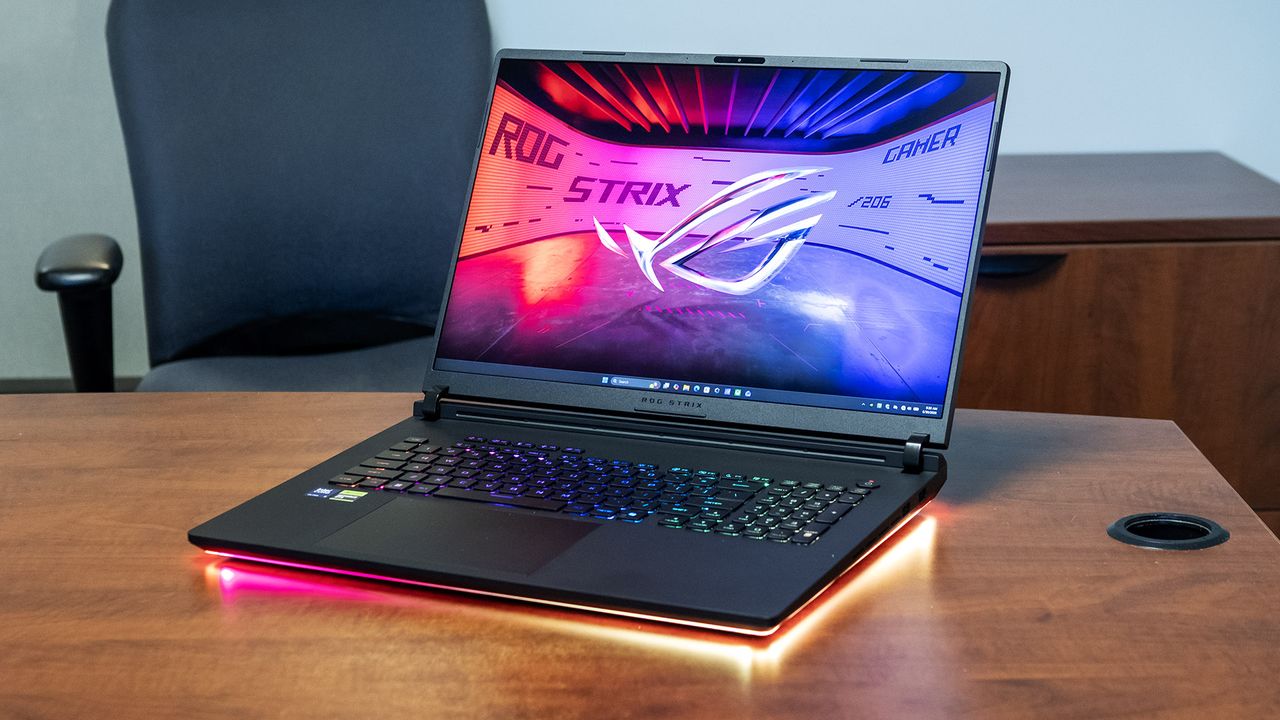
Asus’ ROG Strix Scar 18 (starting at $4,299.99) is an example of abundance in the world of gaming laptops, built around an 18-inch display and the latest flagship silicon: a Core Ultra 9 290HX Plus with Nvidia’s GeForce RTX 5090 in our test unit. This machine makes a loud first impression, from its stellar (albeit tricky to configure) mini-LED display to the unique scrolling marquee lighting on its lid. But at this price – $4,999.99 as tested – the Scar 18 must prove it can hold the line against Razer’s Blade 18 before it can claim a spot at the top.Design of the Asus ROG Strix Scar 18 (2026)At 15.71 x 11.73 x 1.38 inches, the Scar 18 has the footprint of a cafeteria tray – this isn’t a laptop you’ll be getting out on a plane. And at 8.16 pounds, this is also one of the heaviest laptops on the market. But performance is the goal here, not portability. Razer’s Blade 18 (15.74 x 10.84 x 1.1 inches) is thinner and significantly lighter, at 7.06 pounds.Image 1 of 2(Image credit: Tom’s Hardware)(Image credit: Tom’s Hardware)The vibrant Aura Sync lightbar around the base of the laptop also demands attention, as does the RGB-lit Republic of Gamers logo on the lid. Both are configurable with customizable lighting and patterns in the Armoury Crate app.Latest Videos FromThe lid also has a special feature called AniMe vision, a diagonally scrolling marquee of text via LEDs shining through holes in the lid backing. (This is extremely similar to the AniMe Matrix that debuted on the Zephyrus line years ago.) There are several preconfigured versions of the Republic of Gamers logo, and you can add your own text effects. Layered effects are possible and don’t always produce the desired effect — I had a “raining” effect enabled at the same time as my text, and the text was almost impossible to make out.The bottom line is that the Scar 18 couldn’t do anything more to look like a gaming laptop – it is designed to be seen. Build-wise, it’s a solid machine, showing minimal flex no matter how I handled it. Only the lid is metal, with the rest of the construction thick plastic.Connectivity is thoroughly modern: two Thunderbolt 5 (USB-C) and three USB-A 3.2 Gen 2 ports, HDMI 2.1, an audio combo jack, and 2.5 Gbps Ethernet. Internally, it offers Wi-Fi 7 and Bluetooth 5.4 from an Intel BE200 networking card. The power connector is proprietary for the 450 W power brick.Image 1 of 2(Image credit: Tom’s Hardware)(Image credit: Tom’s Hardware)SpecificationsSwipe to scroll horizontallyCPUIntel Core Ultra 9 290HX PlusGraphicsNvidia GeForce RTX 5090 (24GB GDDR7, 1,597 MHz boost clock, 175 W maximum graphics power)Memory32GB DDR5-6400 (1x 32GB)Storage1TB PCIe 4.0 SSD (HFS001TEJ9X101N)Display18-inch, 3840 x 2400, 16:10, Mini-LED, G-Sync, 240 Hz, anti-glareNetworkingIntel Wi-Fi 7 BE200, Bluetooth 5.4Ports2x Thunderbolt 5, 3x USB 3.2 Gen 2 Type-A, HDMI 2.1, 3.5 mm combo audio jack, 2.5 Gbps EthernetCameraFHD IRBattery90 WHrPower Adapter450 W (proprietary connector)Operating SystemWindows 11 HomeDimensions (WxDxH)15.71 x 11.73 x 1.38 inches (39.9 x 29.8 x 3.5 cm)Weight8.16 pounds (3.7 kg)Price (as configured)$4,999.99Today’s best Asus ROG Strix Scar 18 (2026) dealsGaming and Graphics on the Asus ROG Strix Scar 18 (2026)We tested the ROG Strix Scar 18 in flagship form, featuring a Core Ultra 9 290HX Plus processor, RTX 5090 graphics card (175 W maximum graphics power), and 32GB of RAM. This is top-of-the-line gaming technology, though with one misstep: single-channel RAM. This might affect its performance as we’re about to see. The Task Manager confirms that only one SO-DIMM slot was used.Get Tom’s Hardware’s best news and in-depth reviews, straight to your inbox.
(Image credit: Tom’s Hardware)I put the Scar 18 through its paces playing 007: First Light at 3840 x 2400 with all detail settings maxed out. At first, this proved too demanding – I saw 26 to 32 frames per second (FPS) in most scenes. Enabling DLSS more than doubled the frame rate – I saw around 70 FPS or better, and the game was supremely playable.Our comparison lineup includes Alienware’s 16 Area-51 (RTX 5080), MSI’s Raider 16 Max HX (RTX 5090), and Razer’s Blade 18 (RTX 5090). All laptops use a Core Ultra 9 290HX Plus and have GPUs rated for 175 W like our Asus. Their native screen resolutions, however, are different: Alienware and MSI are 2560 x 1600 while Razer has a unique dual-model display supporting both 1920 x 1200 and 3840 x 2400.Image 1 of 5(Image credit: Tom’s Hardware)(Image credit: Tom’s Hardware)(Image credit: Tom’s Hardware)(Image credit: Tom’s Hardware)(Image credit: Tom’s Hardware)The Scar 18 was competitive across the board at 1200p, typically a few FPS ahead of the Alienware but a few FPS behind the MSI and particularly the Razer.Bumping the resolution to 4K, the Scar 18 trailed the Razer in most games – the delta was at or almost 10% in Shadow of the Tomb Raider, Far Cry 6, Cyberpunk 2077, and F1 23. (Red Dead Redemption 2 was the exception.) While those numbers won’t make the difference between playability and unplayability, the price of these laptops makes it difficult to overlook.Differences versus the Razer aside, the Scar 18 still demonstrates ample performance for gaming at 4K in most of the games we tested, though not all – it averaged only 21 FPS in Cyberpunk 2077 on ray tracing ultra, indicating that it won’t be possible to play every game at maximum detail settings.We stress test gaming laptops running 15 loops of the Metro Exodus stress test at RTX settings. During the test, the Scar 18 averaged 141 FPS with minimal variance between runs, starting at 141.5 FPS and finishing at 141.1 FPS. The Core Ultra 9 290HX Plus CPU averaged 4.59 GHz on its P-cores and 2.58 GHz on its E-cores while the RTX 5090 had an average boost clock of 1.98 GHz.Productivity Performance on the Asus ROG Strix Scar 18 (2026)We tested the Scar 18 with a Core Ultra 9 290HX Plus CPU, 32GB of RAM, and a 1TB PCIe 4.0 SSD. Not including a PCIe 5.0 drive seems like a missed opportunity at this price, though Razer does the same thing.Image 1 of 3(Image credit: Tom’s Hardware)(Image credit: Tom’s Hardware)(Image credit: Tom’s Hardware)In Geekbench 6, the single-core numbers between these laptops were almost indistinguishable as we might expect given they all use the Core Ultra 9 290HX Plus, though the Scar 18’s multi-core score of 17,629 points significantly trailed the others, which all scored over 20,000 points.The Scar 18 landed middle of the road in our 25GB file transfer test, averaging 2,042.69 MBps, putting it ahead of the MSI (1,357.93 MBps) and Razer (1,670.53 MBps) but behind the Alienware (2,738.9 MBps).The Scar 18 also proved competitive in our 4K-to-1080p Handbrake transcoding test, completing it in two minutes and 11 seconds to lead the Alienware (2:24) but trail the MSI (1:51) and Razer (2:01).Display on the Asus ROG Strix Scar 18 (2026)The Scar 18’s “Nebula” HDR display is its crowning feature. With a 3840 x 2400 (4K) resolution, mini-LED backlighting with 2,000 dimming zones, a 240 Hz refresh rate, and Nvidia G-Sync, this is quite advanced.Tweaking is required to get this display to perform as intended, and it’s not simple. Out of the box, HDR is disabled, the refresh rate is capped at 120 Hz, and G-Sync is unavailable since Nvidia Optimus, which dynamically switches between the CPU’s integrated graphics and the RTX 5090, is enabled. To unlock maximum performance, the GPU must be put in “Ultimate” mode in Armoury Crate, which is effectively a MUX toggle that disables the integrated graphics. A restart is required for this to take effect. G-Sync, the 240 Hz refresh rate, and a special feature called “Extreme Low Motion Blur” (ELMB) then become available. The latter is aimed at esports players– it manipulates the pixels so that they turn off when switching colors, theoretically eliminating blur. (More on this in a moment.)Those aren’t the only settings you’ll need to know about. You can toggle the mini-LED backlighting control between one zone, multi-zone balanced, or multi-zone strong. These settings produce very different images – one-zone provides the deepest contrast, multi-zone balanced is the dimmest but evens out the contrast to make dark scenes appear brighter, and multi-zone strong is the brightest and most vibrant. I stuck with the latter for nearly everything.ELMB only works in one-zone mode without HDR. I tested it using the Blur Blusters UFO Test. It clearly made a difference – in the 240 fps scrollbar, the UFO looked crisp moving across the screen. Disabling ELMB caused it to become blurry, making it harder to see details. This feature can really matter for competitive esports.But wait, there are even more settings! Armoury Crate includes many color modes through a feature called GameVisual — racing, scenery, RTS/RPG, fps, cinema, eyecare, vivid, and e-reading. On top of that, it also provides color temperature and gamut settings.Then there’s the question of HDR. To get that working, it must first be enabled in the Windows Settings app. Back in Armoury Crate, you’ll find GameVisual, color temperature and gamut settings, Extreme Low Motion Blur, and mini-LED backlighting settings are no longer available. That’s the trade-off.Complicating all this is that the settings I just mentioned are in different places in Armoury Crate. Some are in the display section, while others require going into the Devices section, selecting the Scar 18, and making changes there. It’s not straightforward, and those that simply use this laptop out of the box without tweaking won’t get the best visual experience.After much experimentation, I played 007: First Light in GPU Ultimate mode, G-Sync enabled, a 240 Hz refresh rate, and True Color HDR enabled through Windows. The picture left little to the imagination – colors seemed to pop off the screen and the 4K resolution provided exquisite detail right down to the patches on Bond’s uniform. HDR effects from muzzle flashes and explosions were dazzling in dark environments.When I watched Zootopia 2, I switched off HDR and used SDR multi-zone strong. Colors looked exquisite, and brightness was borderline excessive in a darker room. Bright objects like lamps almost seemed overexposed, but they weren’t – the display was simply that bright, and colors were so saturated that I found it hard to look away.
(Image credit: Tom’s Hardware)The Scar 18’s numbers are from its default out-of-the-box display settings. In color coverage, its 77.9% DCI-P3 coverage was last in the group – Alienware’s OLED screen achieved 93.7% — but is still high enough to create vibrant-looking colors. Its 428.2-nit peak brightness was mid-pack, brighter than the Alienware’s 368.6 nits but well back from Razer’s 538 nits.Also shown in our charts are the multi-zone strong settings, which produced 584.6 nits of brightness, with parts peaking at 625 nits. Enabling HDR, we measured an astounding 1,124 nits at 10%, 1,090 nits at 40%, and 943 nits at 100%. If you’re looking for one of the brightest laptop displays around, the Scar 18 ranks high on the list.Keyboard and Touchpad on the Asus ROG Strix Scar 18 (2026)The Scar 18’s keyboard is great for gaming – the keys require enough actuation force that resting your fingers on WASD or the arrow keys won’t produce accidental presses. Key travel is communicative in the sense your fingers know exactly when a key is at the top or bottom of the stroke. The bright RGB backlight is sharp and easy to see.
(Image credit: Tom’s Hardware)The keyboard is less ideal for productivity. The tactile feel is rather lifeless, though I still managed 126 words per minute with 99% accuracy in my usual MonkeyType run. Layout-wise, a two-thirds-size number pad on an 18-inch laptop is a miss – there’s plenty of space to make it full-size. Additionally, the arrow key cluster isn’t separated out, resulting in no right Ctrl key, and there are no dedicated Home, End, Page Up, or Page Down keys. Asus does, however, provide five dedicated macro keys, a rarity on any laptop. These are configurable in the Armoury Crate app.Asus’ mechanical touchpad is excellent, with an expansive surface and a smooth but fingerprint-resistant surface coating. Its clicking action is quiet.Audio on the Asus ROG Strix Scar 18 (2026)The Scar 18’s quad-speaker array delivers a decent, if not remarkable, audio experience. In 007: First Light, soft details like the footsteps of approaching enemies were easy to pinpoint, thanks to the expansive soundstage – there’s plenty of room to separate the speaker placement on a laptop this large. Bass is muted, though, resulting in explosions and gunfire that don’t stir up as much excitement as they could.In Phil Collins’ “Don’t Lose My Number,” high hats on drum hits were sharp but missed low-end bump. Switching to the Chainsmokers’ “Summertime Friends,” I also noted the lack of bass, though the vocals were crisp. The overall sound signature is on the hollow side, but that can be sharpened up using the Atmos Detailed equalizer in the Dolby Access app. None of the equalizers made up for the lack of bass, though. Volume levels are also moderate – I found myself pushing at least 80% volume for most situations.Upgradeability of the Asus ROG Strix Scar 18 (2026)Getting inside the Scar 18 couldn’t be easier – simply slide the latch below the palm rest, slide the entire bottom panel forward, and lift it away. You don’t even need tools.Upgrade possibilities include two M.2 slots, two SODIMM slots, and the battery.Image 1 of 2(Image credit: Tom’s Hardware)(Image credit: Tom’s Hardware)Battery Life on the Asus ROG Strix Scar 18 (2026)Our battery test consists of web browsing, running OpenGL tests, and streaming videos with the screen at 150 nits while connected to Wi-Fi.
(Image credit: Tom’s Hardware)One minute shy of the five-hour mark, the Scar 18 demonstrates respectable battery life for an 18-inch gaming laptop. The Razer lasted half an hour longer (5:31) and the MSI Raider (8:34) clearly does a better job conserving power, but the Scar 18 did outperform the Alienware (3:33) by several hours.Heat on the Asus ROG Strix Scar 18 (2026)We measure the surface temperatures of gaming laptops while running the Metro Exodus stress test. Peak temperatures were 91 degrees Fahrenheit on the keyboard between the G and H keys, 90 F on the touchpad, and 108 F on the underside near the cooling vents. Internally, the Core Ultra 9 290HX Plus averaged 66 Celsius while the RTX 5090 ran at 64 C.The laptop’s fans are well-behaved for daily use. Though fan noise increases while gaming, I had no trouble hearing footsteps and distant conversations in 007: First Light using the built-in speakers.Webcam on the Asus ROG Strix Scar 18 (2026)Asus’ FHD webcam has the minimum resolution expected on a modern laptop. The picture looks soft and washed out. Highlights aren’t handled that well – a window in the background appeared blown out – and I had trouble making out details on my face from just a few feet away. Gamers who value visual quality will want to invest in an external webcam.Software and Warranty on the Asus ROG Strix Scar 18 (2026)Asus includes a useful software bundle, starting with the familiar Armoury Crate. This app provides component monitoring, a macro editor, game library, an exhaustive amount of display settings, and lighting settings via Aura Sync and AniMe Vision. Accessing some settings is unintuitive since you need to go to the Device section and select the laptop. There you can access Windows key and Touchpad toggles and several display settings, including panel overdrive (240 Hz refresh rate). Most settings can be saved in profiles.The MyAsus app is more generic. In addition to diagnostics and system updates, it provides a battery care mode, microphone noise cancelation, and networking preferences that allow prioritizing traffic to games or other apps.†The Scar 18 also works with Asus’ GlideX app to share content across devices, including phones and tablets.Asus includes a standard one-year warranty.ConfigurationsAsus offers two Scar 18 configurations with only the GPU different between them – model G835LWG-DB96 uses an RTX 5080 for $4,299.99 while our review model, G835LXG-DB96, steps up to the RTX 5090 for $4,999.99. All other components are the same: a Core Ultra 9 290HX Plus processor, 32GB of RAM, a 1TB SSD, and the 18-inch mini-LED display.Pricing is slightly higher than Razer’s Blade 18 with the RTX 5080 – it was $4,099 at this writing. Razer runs $5,399 with the RTX 5090, but that price also includes a 2TB SSD.Bottom LineThe Scar 18 is an undeniably impressive machine that goes all-in on visuals. Its mini-LED “Nebula” display looks breathtaking when properly configured, producing exceptional brightness. The AniMe scrolling marquee, dedicated macro keys, and easy serviceability also elevate its appeal.However, when it comes to performance, the Scar 18’s single-channel RAM and lack of a PCIe 4.0 SSD are significant shortcomings on a $4,999.99 machine. Several of our gaming benchmarks and multi-core CPU performance showed meaningful dips against Razer’s Blade 18. Additionally, while its display is brilliant, the maze of settings required to unlock its potential means it doesn’t provide the best experience out of the box.Overall, the Scar 18 is a formidable and visually stunning laptop with plenty of power and one of the best displays you’ll find in a laptop. It simply doesn’t perform consistently enough to displace the Blade 18 as our top recommendation among elite 18-inch gaming laptops.Asus ROG Strix Scar 18 (2026): Price Comparison
Diterbitkan : 2026-07-10 15:16:00
sumber : www.tomshardware.com