
Microsoft built its most powerful Surface ever on Nvidia’s new chip, and we saw every RTX Spark competitor coming this fall
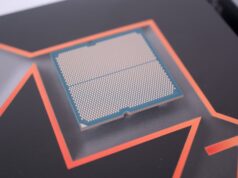
Nvidia, alongisde Microsoft, used Computex 2026 to announce RTX Spark, a chip that puts a 20-core Arm CPU and a Blackwell GPU with 6,144 CUDA cores, the same count as the RTX 5070, on a single package with up to 128GB of unified memory. The CPU side was co-designed with MediaTek, and Nvidia rates it at 1 petaflop of AI compute, enough to run 120B-parameter models locally with up to a million tokens of context. It’s the consumer descendant of the GB10 Grace Blackwell Superchip that powers the DGX Spark and machines like the Lenovo ThinkStation PGX, except this one runs Windows. In a private showcase hosted by Nvidia, we were able to see every RTX Spark-based machine that was announced. Unfortunately, the story told by every OEM is fairly homogeneous. It arrives in fall 2026, there’s no pricing, and spec sheets range from complete to nearly empty, so what we have is what was on display and what each company was willing to say. Still, I’ve used the GB10 extensively for AI workloads and even gaming, and the 5070 comparison isn’t marketing fluff. I’ve run Cyberpunk 2077 at 1440p on the GB10 through FEX and Proton, two translation layers stacked on top of each other, and it still held playable frame rates at maximum settings. These Windows machines only carry one of those layers, since Prism does on Windows what FEX does on Linux and Proton has no job to do at all, so the overhead only goes down from here. Nvidia says more than 30 laptops and 10 desktops are in the pipeline, with Acer and Gigabyte machines to come as well. Here are all of the machines we know are coming, and what we got to see. Disclaimer: Asus paid for my travel and lodging in order to attend Computex 2026 in Taipei. The company had no input into the contents of this article.
Microsoft Surface Laptop Ultra
A Surface with Nvidia silicon inside
Arguably the star of the show, Microsoft calls the Surface Laptop Ultra the most powerful device it has ever made. Oh, and it’s the first Surface with Nvidia silicon since the Tegra-powered Surface RT, the machine that gave Windows on Arm its terrible first impression back in 2012. The company is aiming it at what it calls “world makers,” which translates to creators, developers, and AI researchers, and selling it as an alternative to the MacBook Pro with up to 128GB of unified memory and complete CUDA support on board. After years of Snapdragon and Intel Surfaces, Nvidia is the next big frontier. The display is the standout spec. It’s a 15-inch mini-LED PixelSense Ultra touchscreen at 2,880 x 1,920 and 262 pixels per inch, with up to 2,000 nits of peak HDR brightness, which makes it the brightest panel Microsoft has ever put in a Surface. Mini-LED is an unusual choice in a lineup where most rivals went OLED, but it gets to that brightness ceiling without the burn-in anxiety of an OLED. The machine comes in under 18mm thick and under 2kg, with the largest haptic touchpad on any Surface to date, in Platinum and Nightfall finishes. Port selection is surprisingly generous for a Surface, too: HDMI, USB-C, USB-A, a full-size SD card slot, and a headphone jack. Microsoft’s line is that every port you actually use is on the device, and for once that’s not far off. What Microsoft didn’t share is storage options, battery capacity, or a price, and given the hardware inside, I wouldn’t expect it to be cheap. Microsoft also built its flagship around Nvidia rather than Qualcomm this time, right as Qualcomm’s Windows on Arm exclusivity comes to an end. It arrives later in 2026 with everything else.
Asus ProArt P16 and P14
The most complete spec sheets of the show
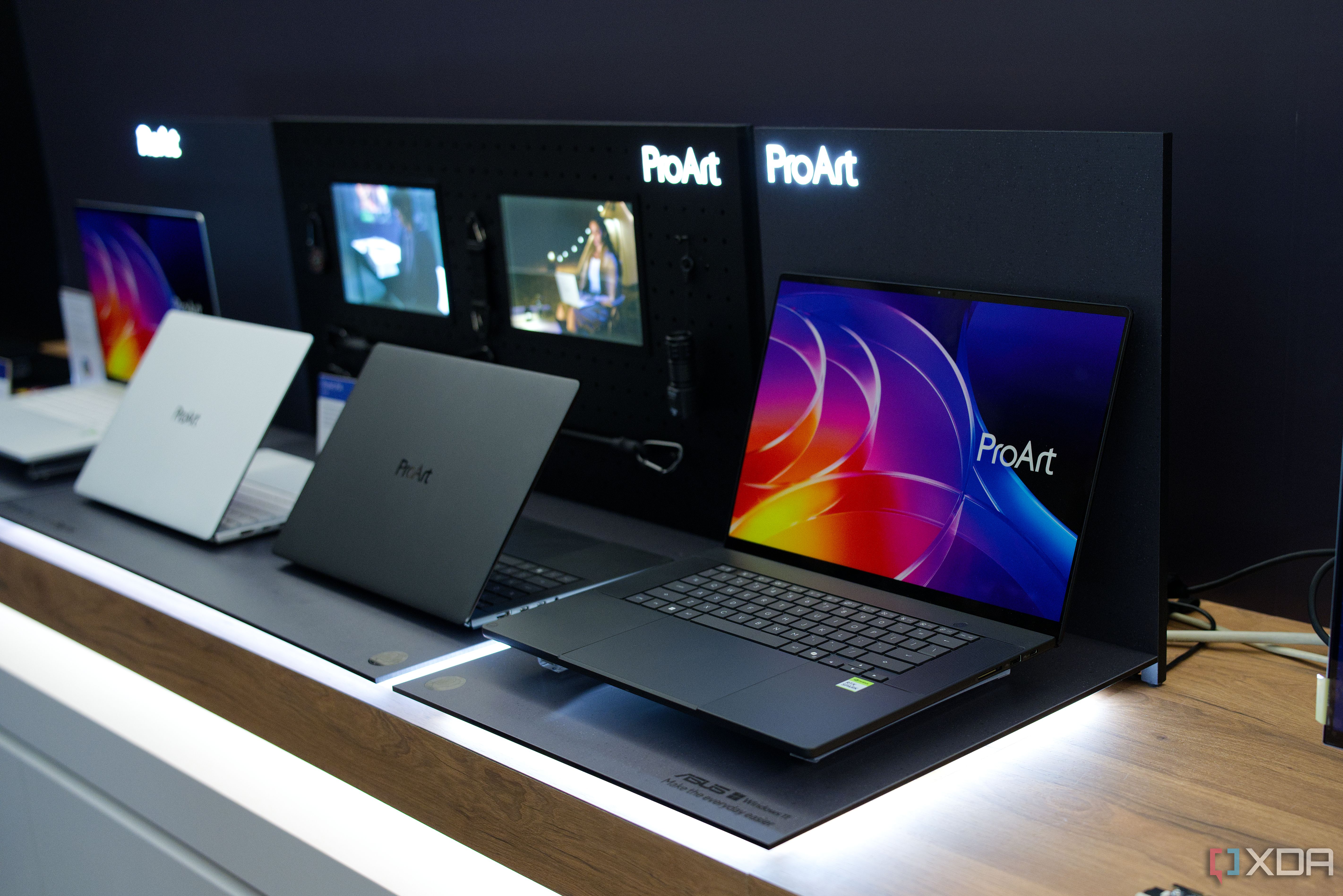
While most OEMs kept their cards close, Asus published actual details for both of its RTX Spark laptops. The ProArt P16 (H7607) is the flagship and the ProArt P14 (H7407) is its smaller sibling, and both are CNC-machined aluminum in Nano Black and Neo White finishes. Asus says the new P16 is 13% thinner and 16% lighter than the model it replaces. The displays are what you’d expect from the ProArt name. The P16 gets a 4K 120Hz Lumina Pro OLED with variable refresh and G-Sync, while the P14 steps down to a 3K 120Hz panel, and both hit 1,600 nits of peak HDR brightness with 100% DCI-P3 coverage, Pantone validation, and Delta E under 1. Asus also fitted an anti-reflective coating it claims cuts reflections by 65%, which matters quite a lot on a glossy OLED when it comes to color grading and general display legibility in the sun. The P16 is 12.9mm thick at 1.77kg with a 99.9Wh battery and up to 2TB of storage, while the P14 is 13.9mm at 1.48kg with a 90Wh battery and up to 1TB. Connectivity is properly creator-focused, with three USB-C ports, a USB-A port, HDMI 2.1, a full-size SD card reader, a headphone jack, and Wi-Fi 7. Asus appears to be pitching the P16 directly against the 16-inch MacBook Pro.
Memory goes up to 128GB of unified LPDDR5X-9400, which is the most important spec for running large local models on this thing. Asus also confirmed an RTX Spark mini PC alongside the laptops, though it shared far less about that one and had nothing to show for it. Like everything else here, there’s no price, and availability is fall 2026 in select regions, but of all the machines I saw, these two are the closest to finished products, if only because Asus alone would commit to a complete spec sheet. Asus later announced a third machine, the ProArt Mini PC, and gave it the most complete spec sheet of any RTX Spark desktop at the show. It’s a 150 x 150 x 51mm box whose chassis is nearly identical to the Ascent GX10, the GB10 machine Asus already sells, with up to 128GB of unified memory, expandable M.2 NVMe storage, four USB-C ports, HDMI, and 10Gb Ethernet. Asus is pitching it against the Mac Studio, and it’s coming in fall 2026 with no price either.
Dell XPS 16 Creator Edition
The XPS name is back for this one
Dell retired the XPS brand in early 2025, replaced it with the Dell Premium naming scheme, and then brought it back at CES 2026, saying it was getting back to its roots. The XPS 16 Creator Edition is the first XPS to carry Nvidia’s full software and hardware stack, so the revived badge’s first big swing is an Arm machine with no Intel inside. That’s not likely to be a choice that Dell made lightly. The confirmed hardware is a 16-inch tandem OLED display with True Black HDR 600 certification, up to 128GB of unified memory, and a built-in SD card reader and HDMI for I/O. Dell’s pitch is 4K 4:2:2 timeline playback, faster exports, and 3D work that would normally choke a thin laptop, which is also the kind of workload this chip was designed for. Beyond that, Dell shared very little: no storage configurations, no battery capacity, and no price ahead of its fall 2026 launch.
Dell also brought a second RTX Spark machine that almost nobody is talking about, a small-form-factor desktop with no name attached. The company was very clear that it was a concept and that the design isn’t final, so what Dell was really showing was a public commitment to building an RTX Spark mini PC. The unit we saw is a small, square box with perforated mesh sides for airflow, two USB-C ports and a full-size SD card slot on the front. There are no specs or a launch window to go with it, but an SD slot on the front of a desktop tells you the creator pitch isn’t limited to the laptops. The commitment makes sense, though. Dell already sells the Pro Max with GB10, a roughly $5,000 mini workstation on the previous chip that runs Nvidia’s Linux-based DGX OS, so it knows there’s an audience for a small box with 128GB of unified memory. An RTX Spark version swaps that Linux workstation positioning for native Windows, and that’s a much bigger potential market than AI developers alone.
HP OmniBook Ultra 16 and OmniBook X 14
Two laptops, one disclosed spec
HP brought two RTX Spark laptops to Computex, the OmniBook Ultra 16 and the OmniBook X 14, and is calling them the world’s thinnest RTX Spark machines. The X 14 measures 13.53mm at the rear and the Ultra 16 comes in at 15.73mm. I’d take the “world’s thinnest” framing with a grain of salt, though, since Asus quotes the ProArt P16 at 12.9mm. The measurements likely aren’t taken the same way, and we won’t know who’s right until someone shows up with a tape measure to verify. Thickness is also more or less the only thing HP disclosed. Both machines support the platform’s headline capabilities, including 12K 4:2:2 video editing and local 120B-parameter models in the 128GB configuration, but HP withheld display specs, storage, battery, ports, weight, and pricing entirely. There was hardware on the floor, but the details are being saved for closer to launch, with both OmniBooks expected later this year.
HP is also building an RTX Spark mini PC of its own, confirmed at the show as a compact desktop on the same platform, with specs fully under wraps and a launch later in 2026. It doesn’t have a name yet, and it’s easy to mix up with the OmniDesk Mini that HP announced at the same event, which is an Intel Core Ultra machine with no RTX Spark inside. If you see people talking about a “HP mini PC” at Computex, check which one they’re about. As with Dell, HP isn’t starting from zero here. It already ships the ZGX Nano G1n AI Station, its GB10 machine, in a chassis that measures just 150mm square, so it has built a tiny computer around this silicon’s predecessor once already.
Lenovo Yoga Pro 9n
The ‘n’ is for Nvidia
Lenovo’s naming scheme is pretty self explanatory: the Yoga Pro 9i is the Intel model, and the new Yoga Pro 9n is the Nvidia one. It’s Lenovo’s first RTX Spark laptop, and it follows the same design language as the 9i, with a 15-inch display, an aluminum chassis, top-firing speakers, and a backlit keyboard. The trackpad is unusually large and supports pen input for drawing, which is a strange feature on paper until you remember who this machine is for. The confirmed details read like a creator checklist: an HDMI port, an SD card slot, and all-day battery life that Lenovo won’t put a number on. The top configuration gets the full 20-core chip with 128GB of unified memory. What Lenovo hasn’t published is the panel’s resolution or refresh rate, and I’d caution against assuming it inherits the 9i’s display, because nothing official says it does. Lenovo is no stranger to this hardware family either, as the ThinkStation PGX it already sells uses the GB10. I’ve used mine to serve 80B-parameter models at up to 40 tokens per second and fine-tune my own 7B model, all from the same 128GB unified memory pool this laptop will ship with. That experience is the most concrete preview of the Yoga Pro 9n that exists right now. The Yoga Pro 9n is that capability moving from a Linux workstation into a consumer Windows laptop, and that’s the entirety of the proposition behind the RTX Spark. Lenovo hasn’t given it an official date or price, but fall 2026 alongside everything else is the safe assumption.
MSI Prestige N16 Flip AI+
The only convertible in the lineup
The Prestige N16 Flip AI+ is the only 2-in-1 in the RTX Spark lineup of announced devices so far, a 16-inch convertible that rotates between laptop, tablet, tent, and presentation modes. As with Lenovo, the naming appears to be self-explanatory, with the “N” denoting Nvidia. MSI is the launch partner that looks like it took the biggest risk on form factor, and I honestly respect it.
The display is a 16-inch UHD+ tandem OLED that stacks two emissive layers to push past 1,000 nits, with touch support and Delta E under 1 for color work. MSI fits a 99.9Wh battery, plus a quad-speaker array and a customizable Action Touchpad. The MSI Nano Pen, a stylus that stows away under the chassis, is also a great little detail for creators. In other words, a digital artist gets a 16-inch pen-input tablet with a color-accurate OLED and a 5070-class GPU behind it, which can run image generation and other local AI workloads on-device instead of requiring the cloud. Storage, weight, and pricing are all undisclosed, with availability in the second half of 2026. Of everything I saw, this is the machine I’m most curious about, mostly because pen-input convertibles almost never get this much GPU. MSI also brought a second RTX Spark machine, and it’s the odd one out of the show. The EdgeMesa N AI+ is a mini PC, and where every other machine here is pitched at creators, MSI is aiming this one at edge AI deployments across healthcare, retail, finance, robotics, and smart city infrastructure. The specs lean that way too, with an emphasis on a 10Gb Ethernet port for moving datasets and talking to inference servers, plus one HDMI and three USB-C ports driving up to four displays. Storage, memory SKUs, and pricing are all undisclosed.
It’s a true platform already
Every machine here ships in fall 2026, and not a single one has a price. Estimates put the top-spec systems at a minimum of $3,000 and up, and given that the GB10 machines cost even more than that, I wouldn’t bet on these being affordable. The hardware itself doesn’t worry me, because I’ve spent months with the GB10 and unified memory at this capacity changes what you can run locally in a way no consumer GPU can match. Nvidia is also treating this as a platform rather than an experiment. It has committed to three generations of Spark silicon, with the current Grace Blackwell chip followed by a Vera Rubin generation on LPDDR6 and a Rosa Feynman generation after that, and Acer and Gigabyte are lined up behind the launch partners. Whatever happens this fall, Nvidia isn’t planning to walk away from Windows PCs after one round. There’s a pattern in the branding, too. Nvidia spent a significant amount of time during its keynote and even in its demos talking up 1440p gaming at over 100fps, yet not one of these machines wears a gaming badge. Dell went with XPS rather than Alienware, Asus chose ProArt over ROG, MSI picked Prestige instead of one of its gaming lines, Lenovo used Yoga rather than Legion, and HP went OmniBook, not Omen. Every OEM looked at a 5070-class GPU and decided gaming wasn’t the pitch, filing it under creator lines for the laptops and edge AI for MSI’s mini PC. Either they don’t trust Arm gaming to be ready on day one, or they know exactly who’s going to pay $3,000 for the first wave. The open question is Windows on Arm. These machines live or die on Prism emulation, which Microsoft says it tuned specifically for this chip, along with driver maturity and whether anti-cheat and legacy software cooperate. Frame counters and frametime overlays were nowhere to be seen during gaming demos at the show, but the reason for that is that the software is changing a lot right now, and frequently enough that any performance figures would mean very little this far from launch. To be fair, the chip held up its end on Linux through two layers of translation, so if Microsoft holds up its end too, this is the biggest shake-up Windows laptops have had since Apple Silicon forced the industry to take Arm seriously.
Diterbitkan : 2026-06-08 15:00:00
sumber : www.xda-developers.com