
18 months later, the RTX 50 series’ biggest feature is still waiting for games that don’t exist
Summary
Multi-Frame Generation works well now, but only a handful of games support path tracing to use it.
The RTX 50 feels like a public beta: clever AI features launched unfinished and software defines the gen.
Next gen needs a real ecosystem: developers must ship path tracing support or the upgrades feel hollow.
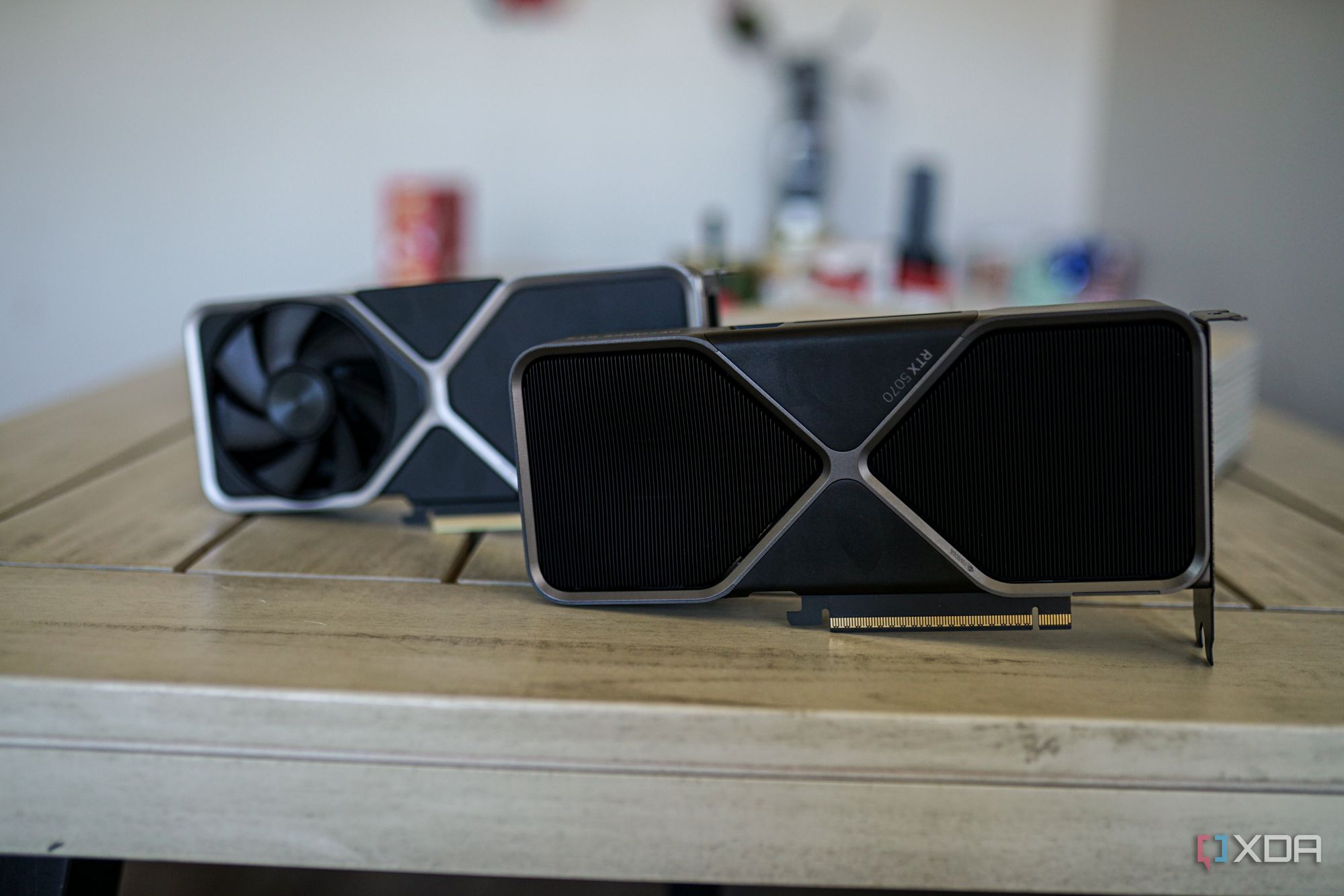
Back when Nvidia launched the RTX 50 series, I remember being amazed at how much the conversation around a new GPU generation had changed. The entire marketing brochure for the Blackwell architecture’s gaming GPU lineup was chock-full of AI buzzwords, and the crowning jewel, which was Multi-Frame Generation. Sure, there were metrics about raster performance, VRAM capacity, and memory bandwidth on the slides as well, but what Jensen Huang kept talking about was Frame Generation, and how it was going from 2x to 4x with the new RTX 50 series. Now, almost a year and a half later, it’s hard to say that the gamble paid off successfully. Since launch, Multi-Frame Generation has improved dramatically for RTX 50 series GPUs, especially owing to DLSS 4.5 and its massive advancements to image quality and stability. However, the games that can truly take advantage of it are still few and far between. As such, the biggest selling point of the RTX 50 series does work, and remarkably well, too, but the circumstances under which it does are a little too rare for Nvidia’s liking.
Related
12 years ago, I left AMD for NVIDIA, and AMD has never given me a reason to come back
NVIDIA’s ecosystem became about much more than silicon, years ago.
The RTX 50-series’ biggest feature still only matters in a handful of games
Multi-Frame Generation is waiting for an ecosystem that barely exists
The RTX 50 series’ biggest selling point was simple: it took Frame Generation from 2x and pushed it to 4x. Nvidia marketed it as the next major evolution of DLSS, but the problem here feels similar to one we can remember with DLSS 1 all the way back in 2019. The technology exists primarily to support path tracing, and path tracing itself remains an incredibly niche feature. Just as DLSS upscaling was introduced to make ray tracing viable on the RTX 20 series GPUs, MFG helps Path Tracing by upping the ante and generating more frames than ever before. Only the number of games that actually feature path tracing in the first place is ridiculously low. We can count on both hands the number of games that have truly showcased the technology so far — Cyberpunk 2077, Alan Wake 2, Black Myth: Wukong, Doom: The Dark Ages, Pragmata, and Resident Evil Requiem. These are pretty much the only AAA titles that genuinely benefit from the full DLSS, path tracing, and MFG stack. This list effectively began forming in 2023 with Alan Wake 2, and here we are in 2026, still struggling to name more than six meaningful examples. Even Nvidia’s latency solution remains incomplete. Reflex 2 still hasn’t arrived. That means that to anyone apart from the uninitiated who simply put on a game and see it through to the finish line, 4x Frame Generation, let alone 6x, continues to have noticeable and immersion-breaking latency and input lag.
Related
Path tracing is slowly becoming a non-negotiable for me, and it wouldn’t be possible without DLSS
Never thought I’d say this, but if it’s got path tracing, I want it on.
Steam charts tell you exactly how little users care about path tracing
Why use MFG when the top 100 games don’t even support path tracing?
Take a look at Steam’s most anticipated releases and MFG doesn’t look all that confidence-inspiring, since it’s only Crimson Desert at number 59 that actually features anything close to path tracing and benefits from Multi-Frame Generation exclusive to the RTX 50 series. Even the latest AAA release, 007 First Light, launched without path tracing implementation, meaning that path tracing in that game will arrive at a later time.
Multi-Frame Generation is intrinsically tied to path tracing, and path tracing is supported by just a handful of games so far.
The RTX 50 series’ biggest USP, Multi-Frame Generation, is intrinsically tied to path tracing, since that is the only scenario where you would need four times the base frame rate for your game to run well or look good, or both. And since path tracing itself is supported by less games than there have been mainline Resident Evil games, we’re looking at that USP failing to live up to its potential.
Related
Nvidia thinks my RTX 20-series GPU is too old for frame generation, but I use it through lossless scaling anyway
All of that for $7!
Nvidia’s “upgrades” are now measured by software features more than hardware
Software is becoming the product, and hardware is becoming the vehicle
Credit: Nvidia
For decades now, GPU generations have been rather easy to understand, because a new GPU simply means more horsepower, more VRAM, more raster performance, and more compute than the one that came before it. With modern GPU launches, that relationship has been becoming rather difficult to see. Take the jump from an RTX 4070 Ti to an RTX 5070 Ti, or from an RTX 4080 to an RTX 5080 — VRAM capacities have remained the same with the new generation, with DLSS features marking the difference between GPUs. Raw gaming performance improvements often stay around the 15–20% mark. Sure, those are improvements, but they’re not nearly as transformative as new GPU generations used to be. We’re approaching diminishing returns in hardware, and that has paved the way for software to become the primary driver of generational progress.
Feature
RTX 20
RTX 30
RTX 40
RTX 50
DLSS Super Resolution (upscaling)
Yes
Yes
Yes
Yes
Ray tracing (RT cores)
Yes
Yes
Yes
Yes
DLSS Ray Reconstruction
Yes
Yes
Yes
Yes
DLSS Transformer model
Yes
Yes
Yes
Yes
NVIDIA Reflex
Yes
Yes
Yes
Yes
Frame Generation (2x, DLSS 3)
No
No
Yes
Yes
AV1 hardware encode
No
No
Yes
Yes
Multi-Frame Generation (up to 6x, DLSS 4)
No
No
No
Yes
Future Reflex 2 support / Frame warp
No
No
No
Yes
DisplayPort 2.1 (UHBR20)
No
No
No
Yes
As such, it isn’t tough at all to predict the near future. Rumors already suggest that the upcoming Rubin architecture for the RTX 60 series has developed path tracing technologies that are capable of delivering massive performance gains over its current implementations. If current RTX 60 series leaks are to be believed, path tracing is about to get twice as fast as that on the RTX 50 series. If those gains do end up happening, it’s almost impossible to see Nvidia making them broadly available across older architectures. The company has every incentive to lock its new AI rendering advances to the RTX 60 series hardware in order to create a “compelling” upgrade path.
Related
I used frame generation wrong for months – here’s what helped
It’s worthwhile when you’re not desperate for it.
With groundbreaking new tech like Neural Texture Compression also relying heavily on AI acceleration and tensor hardware, it’s entirely possible that software-exclusive features become Nvidia’s preferred way of differentiating future generations. Whether or not the consumers benefit from that strategy is an entirely different question altogether.
The RTX 50-series feels more like a beta test than a complete generation
A transitional architecture caught between two futures
I can’t help but look at the RTX 50 series as a bit of a transitional generation rather than a fully realized one. There’s no denying that the hardware itself is pretty darn competent, but so much of its identity revolves around technologies that either arrived late, remain unfinished, or still lack any meaningful software support. DLSS 4 launched before many of its surrounding technologies had properly matured, and it took DLSS 4.5 to genuinely make Multi-Frame Generation feel more convincing than it did at the time of its launch. There’s also the absence of a traditional refresh cycle for the RTX 50 series. Nvidia has always launched Ti and SUPER variants to refresh its lineup mid-generation in order to address any shortcomings. Sadly, the RTX 50 series never really received that opportunity. Instead, it came onto the scene, established its AI-centric direction, and then immediately got overshadowed by conversations about what Rubin might bring next. Sure, the lack of a mid-gen refresh also comes from the fact that global hardware prices and component sourcing prices are completely out of control for both consumers and manufacturers, but it sure doesn’t paint a nicer picture for the RTX 50 series.
And yet, that reality won’t change just how the RTX 50 series will be remembered. For so many enthusiasts, it feels like the destination and more like a public beta for technology that we’ll really see Nvidia fully realize with the RTX 60 series next year, or whenever it comes.
Related
Stop calling it AI slop — upscaling is democratizing high-end gaming for the 99%
Better visuals for those not on the bleeding edge.
The real test starts next year
By the time the RTX 60 series arrives, Nvidia will need a gaming ecosystem that is actually capable of justifying them.
The next twelve months could be extremely important, and much more so than the last eighteen. By the time the RTX 60 series arrives, Nvidia will need a gaming ecosystem that is actually capable of justifying them. Hardware manufacturers build remarkable tools and GPUs, sure, but ultimately, it’s the developers who really get to decide whether or not those tools will become the industry standard. Every conference, launch presentation, and “new generation,” it becomes clearer that the industry is headed towards AI-backed algorithms and neural rendering. The entire time, traditional metrics of graphics performance are taking the backseat. Whether or not gamers come to embrace this kind of future will depend on game developers and their abilities to give players compelling reasons to care. While the technology sure is here, the more important question is if the games will ever arrive in sufficient numbers in order to justify it.
Diterbitkan : 2026-06-06 18:00:00
sumber : www.xda-developers.com