
You can still build a 4K gaming PC for under $1000 — here’s how I’d do it in 2026
To say that PC building as a hobby has become more expensive would be an understatement. The RAM crisis and ballooning GPU prices that never came back down have made it outright unaffordable for some, and for others, an upgrade seems like nothing more than a mirage. If you’re one of those people looking to make their first entry into PC gaming, or you’re looking for an entirely fresh start from an aged-out system, I’m here to tell you that it’s not all doom and gloom. It’s still possible to build a very capable system for a reasonable price in 2026, it just takes some patience and a little bit of compromise. Buying everything new while staying under that budget simply isn’t an option, but the good news is the used market is still quite healthy, and it’s your ticket to a 4K-ready system.
Related
The RTX 30 series is quietly becoming the best GPU value in 2026
A brilliant GPU generation still punching above its weight
The GPU is the part with the least room to maneuver
A used RTX 3080 is the move
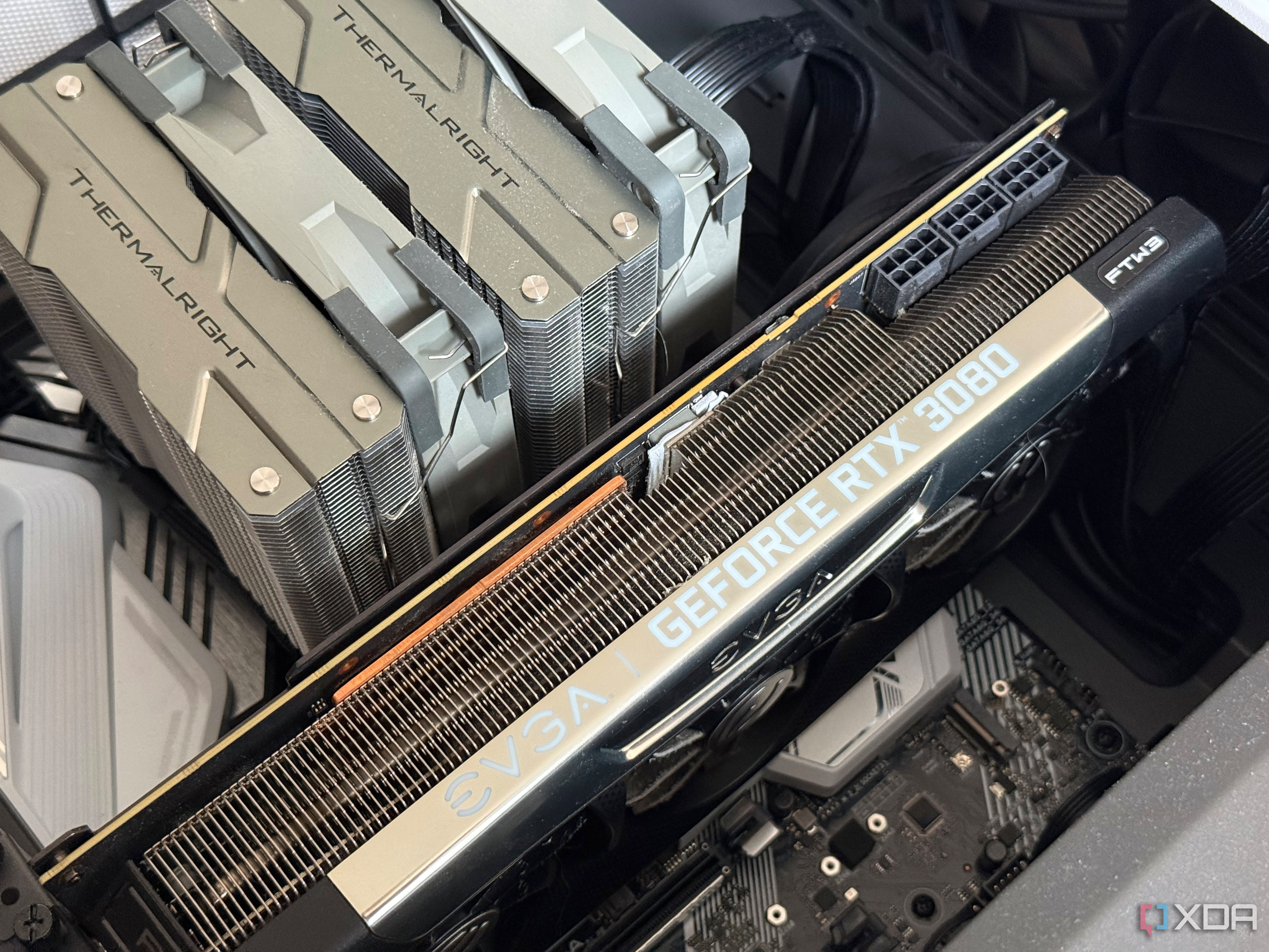
Roughly a third of this budget goes to one component, because at 4K, one component decides everything. The used RTX 3080 has settled into a remarkable position: a card that launched as a $699 flagship in 2020 now regularly sells between $300 and $400 on eBay and second-hand marketplaces, and it remains genuinely capable at 4K with upscaling with the “Quality” preset in the vast majority of games. What makes the 3080 the pick over similarly priced used Radeons is software. Nvidia has kept the entire modern DLSS stack running on Ampere: the transformer-model DLSS 4 upscaler works on every RTX generation, and even the new DLSS 4.5 model released in January is available on 30-series cards. There’s a catch worth knowing: the 3080 lacks the FP8 hardware support newer cards use to run DLSS 4.5 cheaply, so the newest model carries a real performance penalty on Ampere. It’s worth keeping the 4.5 model in the back pocket for when the image-quality gain justifies the performance hit, and default to 4 everywhere else. Buy this part with your eyes open. You don’t know if the card spent 2021 in a mining rig, the thermal paste and pads are five years old, and there’s no warranty behind it. Favor high-feedback sellers, listings with original packaging, and test the card hard within the return window. If you’d rather stay on the Radeon side, a used RX 6800 XT or 6900 XT in the same price bracket is a legitimate alternative, with FSR 4 support now extended to those cards.
Related
I tested the RTX 3080 against the RTX 5080, and upgrading isn’t worth it yet
In Forza Horizon 6 and other AAA titles, the RTX 3080 is still viable
The parts you buy new
Failure is expensive, so don’t risk these ones
Not everything in this build comes from a listing with someone else’s fingerprints on it. Four components should be bought new, and together they run about $285: an MSI MAG A850GL 850W Gold power supply ($109.99), a Phanteks XT PRO case ($59.99), a Samsung 980 500GB NVMe drive ($79.99), and a Thermalright Peerless Assassin 120 SE cooler ($34.90). The case and cooler round out the list mostly because used savings on sub-$60 parts are trivial against the hassle, but there are two components that have more thought behind them.
One of these parts in particular is important to buy new, and that’s the PSU. A power supply is the one component that takes others with it when it fails, and the RTX 3080 is a roughly 320W card with a documented appetite for sharp transient power spikes. This is the worst possible place to gamble on a used unit of unknown age, so any well-reviewed 850W PSU from a reputable brand will do. This is just the one I chose at the time of writing because of its decent price. If you can find a better one, that’s gravy. Of the rest of the brand-new selections, the SSD is the other part that I’d recommend buying from retail, but there’s less risk associated here. If you’re storing nothing but games, a used NVMe that lived its life in a similar fashion will be completely fine running for many years under the same conditions. Your mileage will, of course, vary here, and depending on how you approach the next section, you might not need to buy a brand-new SSD anyway.
Related
5 things I’d do differently if I were building a gaming PC today
The PC hardware market has changed, and I need to change with it
A used platform closes it out
And sidesteps the RAM crisis entirely
Here’s the key to this entire build, and it’s why the math works. With around $350 on the GPU and $285 on new parts, roughly $365 remains before the build crosses that $1,000 mark.
A complete used CPU, motherboard, and RAM combo fits inside it comfortably. Ryzen 5600-class AM4 combos with 16 GB of DDR4 currently sell for around $300 on eBay, and Intel equivalents in the 10th-through-12th-gen Core i5 range land in the same territory. You can even find i7 and Ryzen 7 combos if you’re willing to be patient and maybe participate in an auction. You’re looking for listings that have a CPU installed in the motherboard and at least 16 GB of DDR4, of which there are plenty. My own HTPC setup can be found for under $350 quite easily: an i7-10700K and 16 GB is more than enough to feed that RTX 3080. And that’s the truth for even the Ryzen 5 systems. The performance sacrifice is smaller than it looks, because at 4K the GPU is the bottleneck. That five-year-old six-core costs you single-digit percentages in most titles at this resolution, if it costs you anything at all.
Related
7 worst purchase decisions to avoid when building a gaming PC
Some mistakes are minor, but these PC building purchase decisions are anything but
If you were to buy a new platform, it brings you over $1,000
But not by much
Maybe you’re willing to bite the bullet on a pre-owned GPU, but not an entire CPU platform. If that’s the case, you’re looking at breaking that $1,000 ceiling.
To illustrate this with similarly performing parts, I chose a Ryzen 5 7600X at $166, a Gigabyte B840M Gaming Plus WiFi6E motherboard at $119.99, and a single 16 GB stick of Patriot Viper Elite 5 DDR5-6000 at $199.99. That’s $485.98 for the platform alone, bringing the build to around $1,120.
Paying $200 for one stick of RAM feels very dirty, and the 7600X isn’t a huge difference maker unless you’re playing CPU-bound titles, but it affords you an upgrade path on AM5, which is something that a used platform with a 10th Gen i7 or Zen 3 CPU doesn’t. You could slot in the current gaming king, a Ryzen 7 9850X3D, into this system in the future without needing to empty the bank for a new motherboard and RAM. The cost is running single-channel memory and breaking that $1,000 barrier, so the choice is yours.
Related
You can finally build a monster 4K gaming PC for only $1,200
Ultra 4K gaming has never been this cheap
4K isn’t out of reach for new builders
This build asks a lot of you. You have to trust a selection of pre-owned parts, some of which are the most load-bearing in a gaming system, and you have to find those parts in the first place. You can opt for a new platform, but staying under that magic number requires some concessions in the form of used hardware in some area of the build. Buying used has always been the route for frugal PC gamers, and to me, it’s still the best way to build something capable on a budget.
Diterbitkan : 2026-07-07 23:00:00
sumber : www.xda-developers.com