
Some of my smart devices were sneaking around my Pi-hole, and blocking them was easier than I thought
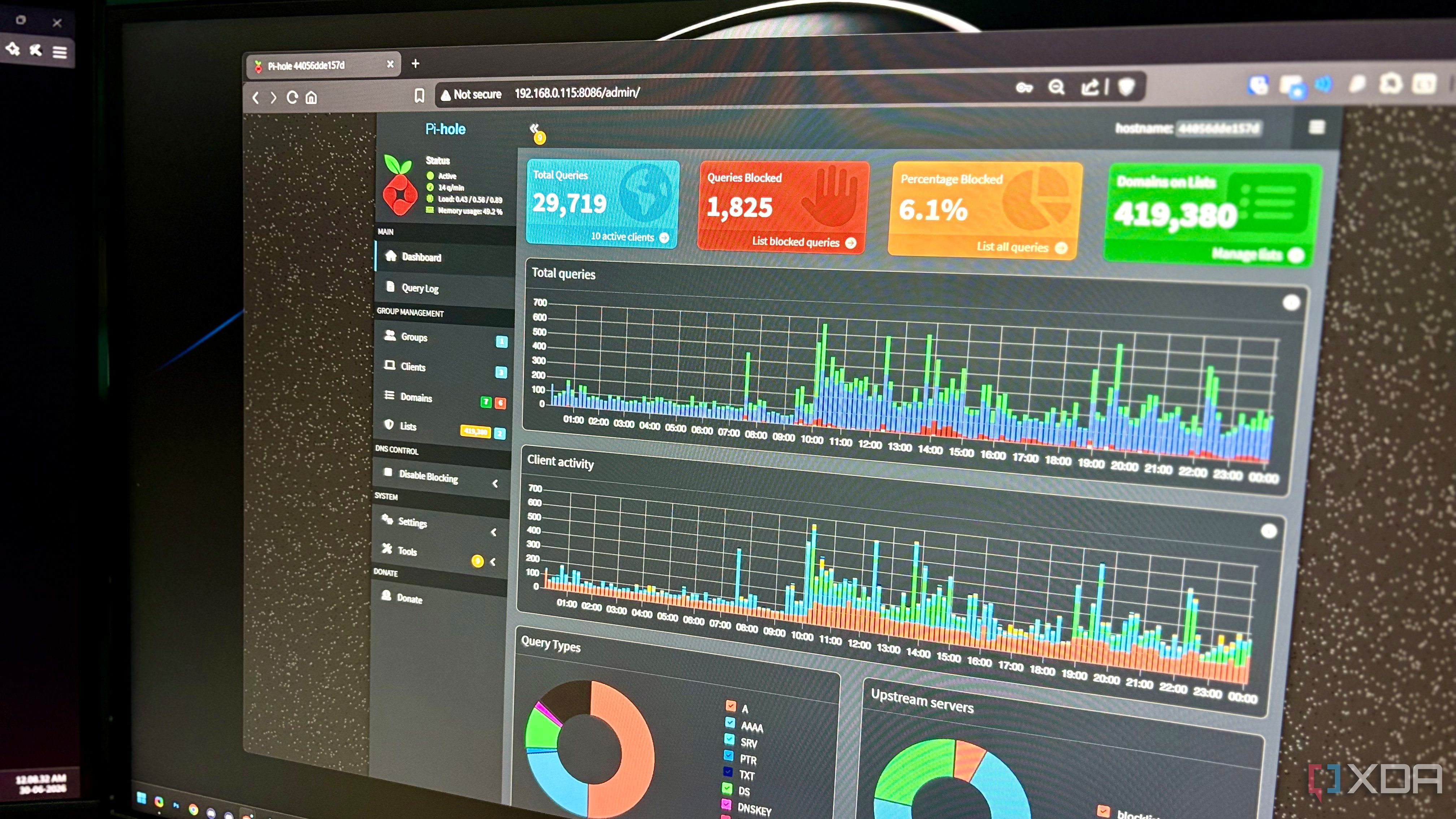
When I implemented Pi-hole on my home network, I thought of it as a set-and-forget thing, as most of the community discussion suggested. I installed Pi-hole on my home Debian server, added a couple of reputable blocklists, and set it as a default DNS on my dual-WAN gateway. And for a while, it really did seem like the job was done. Ads disappeared, obvious trackers filtered out, and the dashboard showed me thousands of blocked queries. Out of curiosity, I’d made a habit of randomly checking the dashboard. That habit stopped being just curiosity when I filtered the query log by the local IP address of each device — specifically, my smart devices. I noticed my IoT devices were talking throughout the day, even while sitting idle. I started investigating those queries, and the investigation turned out to be far more interesting than the fix itself.
Related
5 reasons a Pi-hole isn’t enough to protect your home network
The humble Pi-hole is great for ad blocking but it’s only part of a well-designed home network protection system.
My blocklist was lying to me
The query log told a different story
DNS wasn’t part of my initial stack when I built my homelab. Pi-hole started as an ad blocker and gradually evolved into my default DNS for my whole home network. Even when I only used it as an ad blocker, I used to check the query log every once in a while, not because I was troubleshooting something but as an occasional habit. While setting up Pi-hole, I used the most recommended blocklists: OISD big list and Steven Black’s unified host blocklists. And I assumed that if one of my devices were using Pi-hole, the community blocklists would already be enough to catch telemetry and track traffic. This was all good and working as expected until I tried to filter queries by device via their local IP addresses. I do have a number of IoT devices, such as an Amazon Echo Dot, two Amazon Fire TV Sticks, multiple smart switches like Tapo P110, smart bulbs, and Android TV boxes. Filtering by individual IP addresses told me a different story. I specifically chose three of my most-used IoT devices — an Echo Dot, a Fire TV Stick, and a Tapo P110 — and started digging. Combined, they were responsible for thousands of requests in a single day, and I noticed multiple Amazon domains appearing repeatedly alongside TP-Link’s Tapo cloud domains. The surprising part was that most of the requests passed by Pi-hole easily. Tapo was communicating with domains like use1-cvm-api, aps1-device-cloudgateway, and security.iot.i.tplinknbu.com throughout the day. Echo Dot’s diagnostic AWS domains were wildly repetitive, such as web.diagnostic.networking.aws.dev and its regional variants (ap-south-2, ap-east-2), firing almost every minute. But in the case of the FireTV Stick, there were multiple requests every minute, but fortunately, some of them were already filtered out by Pi-hole, such as mobile-collector.newrelic.com and api.statsig.com. These were generic third-party analytics SDKs, so the community blocklists already covered them. But there were still a few that blocklists didn’t touch, such as Amazon’s own infrastructure domains like unagi-eu.amazon.com and the hashed a2z.com device-identifier domains. After all that, it was a challenge for me to figure out which of the remaining domains could disappear without taking the device down with them. Because one bad guess and I could make my Echo Dot unusable.
Not every domain deserves a free pass
One bad guess and Alexa goes silent
Looking at the logs, my first instinct was to block everything. But these were smart devices that required the internet to operate properly, and blocking everything meant blocking them from the bare minimum they needed to work. If I blocked the wrong endpoint, it could break the voice assistant or halt cloud control, firmware updates, or account authentication. So, I started figuring out which domain did what and started putting them into two buckets. Pure telemetry that was safe to kill, like AWS diagnostic endpoints (web.diagnostic.networking.aws.dev), device identifier services (*.us-east-1.prod.service.minerva.devices.a2z.com), and background reporting (unagi-eu.amazon.com). And the domains the device actually needed to function, such as Alexa APIs (api.amazonalexa.com), the TP-Link cloud gateway (aps1-device-cloudgateway.iot.i.tplinknbu.com), and anything that obviously handled commands, authentication, or device communication (use1-cvm-api.i.tplinknbu.com). A few more signals helped me differentiate them, such as how often they appeared and whether the requests occurred even when the device was idle. And a few domains were just telling the story of what they did: security.iot.i.tplinknbu.com, for example, didn’t feel safe to block on a guess; it looked like something Tapo genuinely depended on. A few hours of internet research, plus a bit of my instinct, and I was ready to filter these out from my network.
The fix was smaller than the investigation
I didn’t need a better blocklist. I needed six lines
Once I was done with the investigation, I had a shortlist of domains that were safe to block and another that was required for the devices to work. But there were still a few that needed to be cross-checked, as the name suggested a different story. I went through multiple community discussions and official documentation before making a final decision. Security.iot.i.tplinknbu.com, at first glance, looked important, and later I discovered it was. Reports suggested it was involved in Tapo’s cloud connectivity, and that blocking it could interfere with the normal operation of the smart switches. Another was msh.amazon.co.uk. It looked important at first, but it turned out to be less critical than expected. Blocking it wouldn’t kill my Fire TV Stick, but it could slow app install speed, so I decided to give it a free pass.
With the uncertain domains out of my way and a good shortlist of domains to block, the implementation was a couple of minutes’ work on the Pi-hole dashboard. I added six entries to the Pi-hole deny list. Four of them were exact-match domains, and two of them were wildcards.
api.statsig.com
mobile-collector.newrelic.com
firetvcaptiveportal.com
unagi-eu.amazon.com
(\.|^)prod\.service\.minerva\.devices\.a2z\.com$
(\.|^)diagnostic\.networking\.aws\.dev$
I waited a few hours to settle everything down. The results were clean. Most of the unnecessary queries were being blocked for the Echo Dot, Fire TV Stick, and Tapo P110 afterward. Telemetry domains now consistently showed “Deny” instead of “Allow”. And most importantly, all the devices were working as expected. In the end, the fix was just six lines added to the Pi-hole denied list. The hard part wasn’t adding them to the blocklist but hours of figuring out which one belonged there.
Related
Pi-hole showed me 65,000 DNS queries in hours, and I didn’t like where they were going
The quietest part of your network talks a lot.
Set-and-forget was the real bug
Pi-hole wasn’t failing. It was already filtering thousands of third-party trackers. The blind spots were vendor-specific telemetry that generic community blocklists weren’t built to catch. After the whole investigation, my old set-and-forget instinct changed to actually reading the query logs every once in a while. Spending only a few minutes on the logs could reveal patterns that community blocklists often miss. In my case, six lines across three devices were enough. The rest of my network is probably hiding a few of its own.
OS
Linux
Price model
Free
Pi-hole is a network-wide ad blocker that acts as a DNS sinkhole, preventing unwanted ads, trackers, and malicious domains from loading on any device connected to your network. It runs on lightweight hardware, such as a Raspberry Pi or in a virtual machine. By intercepting DNS queries, Pi-hole blocks ads before they ever reach your browser or apps, improving speed and privacy. It also provides an easy-to-use web interface for monitoring and managing network traffic.
Diterbitkan : 2026-06-30 23:00:00
sumber : www.xda-developers.com