
Why James Dolan’s second apron comments raise big questions about Knicks’ ability to keep championship roster
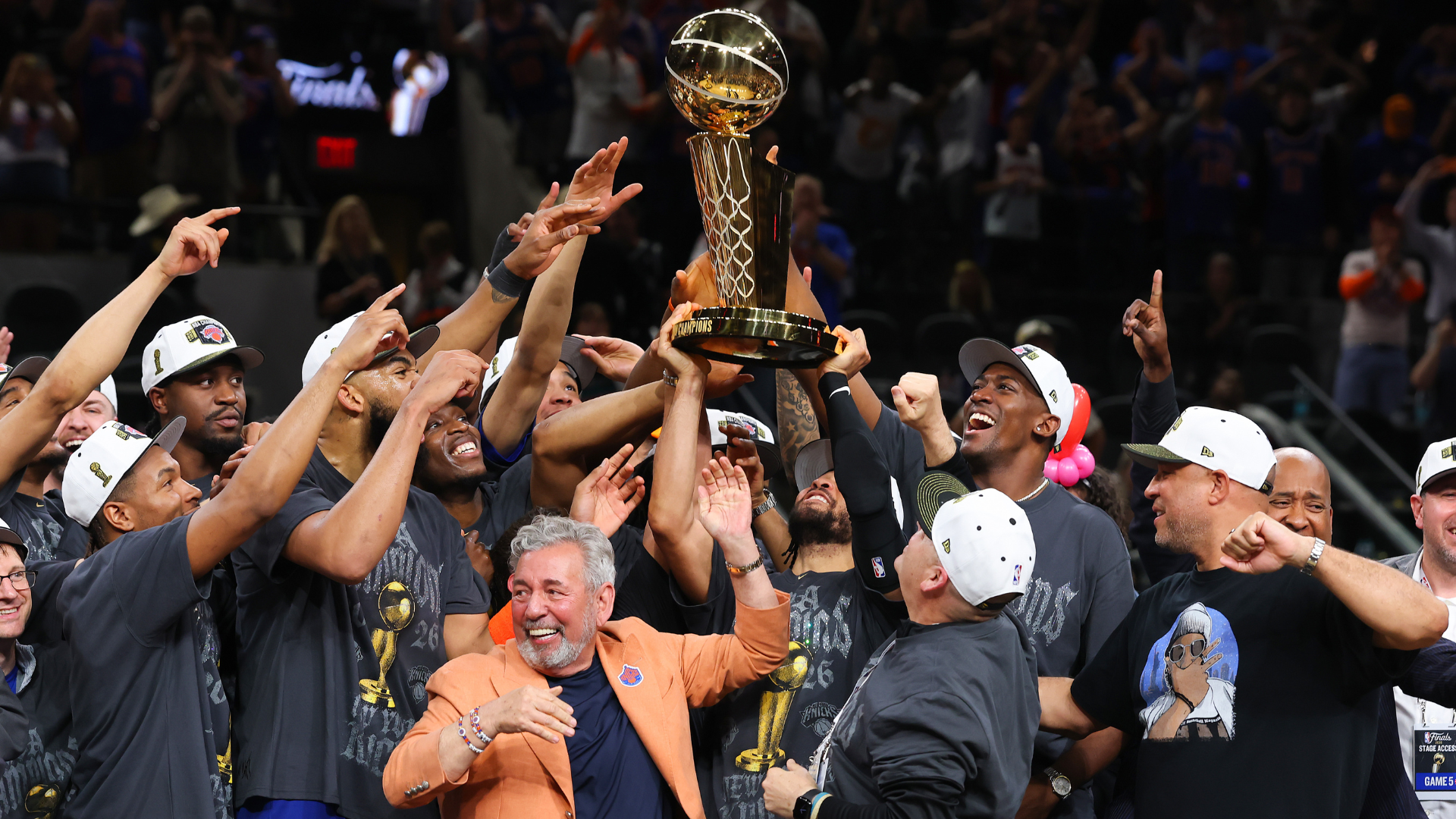
Let me introduce you to a concept I like to call “the sportswriter’s lament.” After the New York Knicks won the NBA championship on Saturday, I wrote an extensive offseason preview that largely operated under the premise that they would be willing to go above the second apron ahead of next season. Doing so would have made sense. They have a championship roster. They are a high-revenue franchise playing in the NBA’s biggest market. Their contract structure, dating back to the Karl-Anthony Towns trade, even hinted at a four-year plan in which the Knicks ducked the second apron for two years, went above it for two years, and then ducked back down below it before the worst penalties (a first-round pick moving to No. 30) kicked in. It all made sense on paper. But as so often happens in sports, plans can change on the word of one powerful figure.And so it might be for the Knicks as they consider how to defend their 2026 championship, because team owner James Dolan appeared on The Carton Show on WFAN in New York on Wednesday, and he seemed to indicate that the Knicks do not, in fact, plan to go into the second apron.
“If we could bring back the whole team, exactly as it is, why wouldn’t you? But I don’t know if we’re going to be able to,” Dolan said. “We’re willing to stretch, but there’s certain things in the NBA that you’d have to be suicidal to do. One of them is called the second apron. Cannot go into the second apron. But that’s up to Leon (Rose).” When host Craig Carton joked that Rose, the team president, makes the decisions and Dolan just signs the checks, Dolan responded with a chuckle, “I’m just telling him how big of a check I can write. I’ll write as big of a check as possible, but I can’t write a check that goes into the second apron.”Dolan’s comments suddenly make the notion of the Knicks running their entire roster from last season back far more complicated, though comments made by a team owner on a radio show are far from binding. It is entirely possible that Rose convinces Dolan that it does make sense to go above the second apron. Nonetheless, Dolan’s comments force us to prepare for a summer in which the Knicks duck the second apron.
So if the Knicks are indeed treating the second apron as a hard cap, and if we assume that none of their five expensive starters (Towns, Jalen Brunson, OG Anunoby, Mikal Bridges and Josh Hart) are going anywhere, what does that mean for New York’s ability to retain their key backups like Mitchell Robinson and Landry Shamet?What is the second apron and what does it do?The NBA’s salary structure includes four basic thresholds, and each mean different things. The lowest is the salary cap. If you’re below the cap, you can sign free agents or trade for players using the amount of space below the cap you have. The second is the luxury tax. It is much higher than the cap, and teams whose total salary exceeds it pay a tax that is partially distributed to non-taxpaying teams based on how far above that line they went and whether or not they are a repeat payer. The next two, which get progressively higher, are the aprons. The first imposes minimal but notable team-building restrictions. The second imposes the following harsh restrictions:
You cannot aggregate salary in trades, meaning, for example, you cannot trade two $5 million players for a $10 million player.You cannot use the taxpayer mid-level exception to sign a free agent.You cannot trade cash.You cannot acquire a player from another team by sign-and-trading them for your own player.You are also beholden to all of the restrictions that come with going above the first apron. Those include being unable to use the nontaxpayer mid-level exception, being unable to take in more money through a trade than you sent out, being unable to sign waived players if their previous salary was above that nontaxpayer mid-level exception, and being unable to use trade exceptions generated in the prior year.These aprons are enormously restrictive and designed as a deterrent. Meaningfully altering your team from above those lines is difficult. Retaining your existing players is far easier, but there is another, harsher deterrent for doing so recklessly.
NBA offseason predictions: Experts pick landing spots for Giannis, LeBron, Kawhi and more
Sam Quinn
We still haven’t covered the second apron’s harshest restriction: If you finish a season above the second apron, your first-round pick seven years into the future gets “frozen.” This means it cannot be traded. If you stay below the second apron in three of the next four years, that pick is unfrozen and can be traded. If you remain above the second apron in two of the next four years, however, that pick automatically falls to No. 30.Thus far, no team has been willing to stay above the second apron long enough to drop a pick to No. 30. Some teams have treated the second apron as an informal hard cap, effectively refusing to go above it for any reason. The Knicks may be one such team. Even after a championship, they may not be willing to make the necessary sacrifices in terms of flexibility to cross that line.
How close are the Knicks to the second apron?The second apron for the 2026-27 season is currently projected at $221,737,000. The Knicks, as of this moment, have $208,776,828 in obligations to 10 players. Eight of those players have guaranteed contracts: Towns, Anunoby, Brunson, Bridges, Hart, Miles McBride, Pacôme Dadiet and Tyler Kolek. Jose Alvarado has a $4.5 million player option, but he is extension eligible. If the Knicks want to keep his salary low for next season, they can still give him a long-term deal. And then there’s the No. 24 overall pick, which comes in at around $3.3 million.Therefore, at least at the time of this writing, the Knicks have a bit less than $13 million in room beneath that second apron line. Teams need to have a minimum of 14 players on their roster, so this is not as simple as clearing out money to pay Robinson. The Knicks have to field an entire team. The rookie minimum is projected to be slightly below $1.4 million, while the veteran minimum is around $2.5 million. So if the Knicks want to keep Robinson or even Shamet, they have work to do.
Can the Knicks re-sign Robinson and stay below the second apron?The immediate answer here would be that it is unlikely. The floor for Robinson would probably be the nontaxpayer mid-level exception, which is projected at around $15.1 million. Teams with cap space could offer him even more, but there will almost certainly be offers in that range. Say the Knicks want to fill out their roster with two veteran minimum contracts and one rookie minimum along with Robinson. They’d be looking at around $6.7 million in space for one last player, presumably Robinson. That’s not going to get it done.Do they have ways of trimming more money? A few. Say they traded their No. 24 pick for future draft capital and replaced it on their balance sheet with another veteran minimum. That’s almost $900,000 in extra room created. Trading Dadiet into someone’s cap space or exception and replacing him with a minimum clears another $500,000 or so. Those savings get even bigger if you’re willing to sign rookie minimums instead of veterans, but this is a championship team that relied heavily on its depth. The Knicks are going to want real players, not just roster fillers.There’s another trick the Knicks can potentially use to find savings later, but it’s a gamble. In theory, they could go above the second apron now and then find a way back below it later on. While you are subject to restrictions at any point while you are above the line, if the penalty the Knicks are most eager to duck is the frozen pick, that one only comes into effect once a team has finished a year above the second apron.
NBA offseason bold predictions: Stars on the move, LeBron James leaves Lakers, Draft shocker and more
Brad Botkin
To that end, teams have developed a bit of a trick to avoid the luxury tax that might be applicable to the Knicks here. Take the Celtics. They were above the tax line last year, but at the trade deadline, they traded away several of their minimum-salary players: Xavier Tillman, Josh Minott and Chris Boucher. They did this because those players, signed before the season, counted on their cap sheets as full, minimum salaries. However, when you replace such players during the season with newly signed free agents, their salaries are prorated. Sign someone for half of the season, for instance, and only half of their minimum salary counts on your books. The Celtics took this strategy to the extreme. Teams are technically allotted 28 days throughout the regular season in which they can have fewer than 14 players on their roster, and no more than 14 of those days can come consecutively. So the Celtics tap danced on the line: using those days in increments and separating them with 10-day contracts to sneak below the tax line.This strategy is fraught, though. There is no guarantee that you’ll find teams willing to help you by taking on your contracts, though the Knicks keep a ready enough supply of second-round picks that they can incentivize teams. But there’s no guarantee that such suitors will even exist. Roster spots aren’t always easy to find during the season.
The Knicks have one of the NBA’s best cap strategists in Brock Aller. If any team could pull off starting the season above the line and getting below it in February, it’s probably them. But no version of this calculation guarantees Robinson’s return. At best, the Knicks could probably put forth a competitive (but not quite matching) offer for Robinson while retaining a path below the second apron. More likely, the gap is too big to bridge. So if Robinson leaves, what does that mean for New York’s offseason?If Robinson leaves, what does the Knicks’ offseason look like?It should be noted that Robinson is not the only meaningful free agent here. Next on the docket is Shamet. All of those complicated paths to paying Robinson could theoretically apply to keeping him on his Early Bird Rights. However, if the Knicks do let Robinson go, I suspect Shamet would also get offered enough by another team that New York would let him walk. The Knicks have McBride and Alvarado in the building as backup guards. They found Shamet on the minimum. They likely feel confident in their ability to find the next Shamet on a similar bargain.So let’s say that’s how this plays out. The Knicks lose two of their most important reserves, Robinson and Shamet, but remain around $13 million below the second apron. There is at least one notable silver lining: staying below the second apron makes it far, far easier to keep restricted free agent Mohamed Diawara. The No. 51 overall pick in last year’s draft may not have played much in the playoffs, but he is a big defensive wing who shot 37% on a small sample of 3s late in the season. He has a lot of upside, and the rest of the league knows it.
Diawara is headed for restricted free agency. The Knicks technically maintain the ability to match any offer sheet he gets, but they have to actually be able to pay whatever contract he signs. With only non-Bird Rights, they are extremely limited in what they can offer: $200,000 plus his minimum salary, for a total close to $2.4 million. If any team offered more than that, they’d be at risk of losing him. However, staying below the second apron would give them access to the $6 million taxpayer mid-level exception, a tool they could use to go higher if they wanted to. Losing Robinson and Shamet would hurt, but it would at least make it far likelier that the Knicks could retain one of their more promising younger players.Still, they’d be shorter on guards than they were during their championship run and completely devoid of backup centers. The former is pretty solvable. Jordan Clarkson could come back at the minimum. There are always playable guards on the market. Ariel Hukporti could also come back at center, but the Knicks have only ever used him as a third-stringer. Maybe the Knicks could find their backup in the draft. They have the No. 24 and No. 31 picks, so maybe they could trade up for a specific target. Realistically, though, they’d probably want a veteran.The good news for the Knicks? They’re a very desirable destination for backup centers. Towns is frequently in foul trouble, so minutes are available, and of course, they’re a big market coming off a championship. The bad news? It’s not a great year for backup centers in free agency. Most of the good ones are likely to re-sign with their existing teams. Their best bets would probably be younger players hoping to join a high-profile team to boost their value.
Ranking top 40 NBA free agents: Austin Reaves, Jalen Duren, LeBron James top list for 2026 offseason
Sam Quinn
Moe Wagner probably returns to Orlando to stay with his brother, Franz, but he might be an option. Nick Richards has been linked to the Knicks at previous trade deadlines. Go a bit older and maybe Andre Drummond is available for the minimum if Philadelphia caps itself out by retaining Kelly Oubre and Quentin Grimes. The Knicks likely have minimum-level targets in mind for just this scenario. Maybe there’s a trade to be made on this front as well.I’m going to throw out a pretty unlikely option, but the last few years of free agency have produced plenty of unexpected minimum contracts. What about Mark Williams? The Suns have to find minutes for No. 10 overall pick Khaman Maluach, and Oso Ighodaro passed him in the pecking order last season. The Suns have around $15 million in room below the luxury tax line, but also have to re-sign key guards Collin Gillespie and Jordan Goodwin. In order to make Williams a restricted free agent, the Suns have to make him a one-year, $9.6 million qualifying offer. If they’re worried about him taking it and vaulting them into the tax, perhaps they cut him loose. He could get more money and minutes elsewhere, but a high-profile backup job on a big-market contender, even for an injury-prone center, can eventually lead to rich contract offers. We know that because it’s happening for Robinson now. So maybe Williams could bet on himself with a cheap, one-year Knicks contract.Something to keep in mind, though, is that if the Knicks aren’t willing to go into the second apron now, after winning a championship, they may not be willing to do so under any circumstances. If that’s the case, it raises real questions about their ability to retain key depth pieces multiple years down the line. Are we sure they’d be willing to extend Alvarado at a fair number in that world? If the answer is no, he might use that player option to cash in elsewhere. Kolek is available to replace him in-house, but there are only so many losses any contender can sustain. McBride is a year away from free agency. Will the Knicks pay what it takes to keep him?We don’t have good answers for these questions yet. The Knicks surely have a long-term vision for their balance sheet. If that vision involves ducking the second apron next season, well, there’s a good chance New York’s bench will look very different for its title defense.
Diterbitkan : 2026-06-18 01:19:00
sumber : www.cbssports.com