

A laser projector replaced my living room TV, and I’ll never go back to regular movie nights
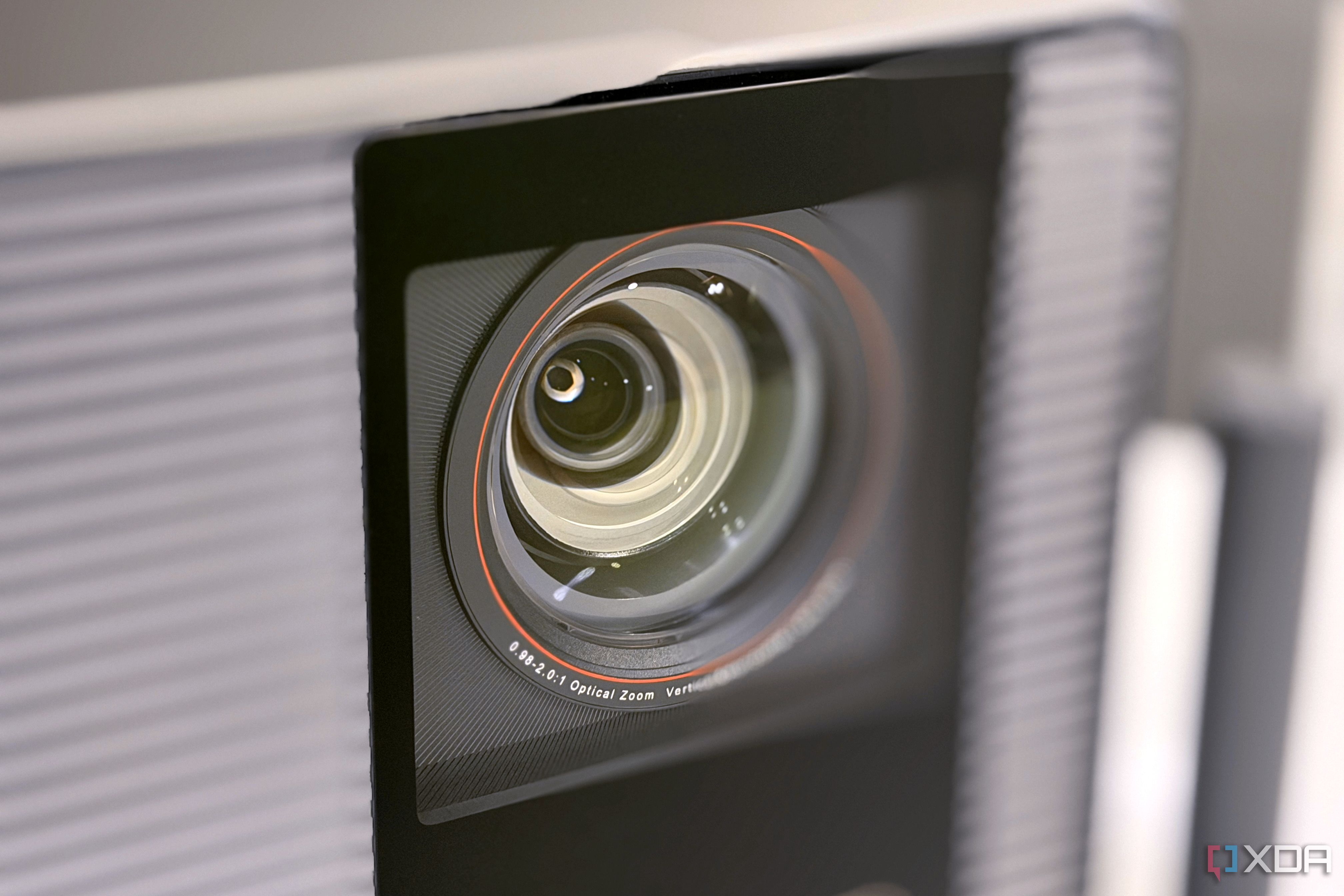
I’ve spent years telling myself a big OLED was the endgame for movie watching, and then a laser projector landed on my coffee table and ruined the plan. My XGIMI Titan Noir Max review covers the specific unit doing the ruining, but this piece is about the bigger argument: for movies, specifically movies, a modern laser projector beats a QLED or OLED TV. I know how that sounds coming from someone who also knows projector brightness claims get inflated, so believe me, I went into this ready to be disappointed. I wasn’t. Yes, TV wins a few categories, but it’s the overall experience with laser projectors that wins for me. Once you’ve watched something in IMAX at 150 inches in your living room or bedroom, even a 75-inch TV starts to pale in comparison. I want my movies to feel like movies, and projectors are the closest to going out to the theater, minus the sticky floors.
Related
This $4,000 projector has a trick no other laser can do, and it fixes the most annoying problem
This lifestyle projector is in a class of its own
A 150-inch picture costs less than a 97-inch panel
Movies were made for the silver screen, not for slabs
Let’s start with the math that made my brain sit up. The largest OLED you can actually buy tops out around 97 inches, and it costs several times what my projector did. Meanwhile, the Titan Noir Max will throw a clean image up to 300 inches, and even at a sensible 120 to 150 inches, you’re getting roughly double the diagonal of a flagship panel for flagship-panel money. Screen area scales with the square of the diagonal, so a 150-inch image isn’t twice the size of a 75-inch one. It’s four times the size. No panel technology scales as well as light does. But size is only half of this section’s argument, because the other half is what that size does to the movie itself. Films are graded for a big reflected-light image in a dark room, and that’s exactly what a projector produces. The Titan Noir Max handles the full HDR stack, from HDR10+ and Dolby Vision through IMAX Enhanced and Filmmaker Mode, and it plays 24fps content the way the director intended, rather than smoothing it into a soap opera. Reflected light is also kinder to your eyes during a three-hour epic than staring at an emissive panel with the brightness cranked up. Sure, a TV can display the same formats. But there’s a difference between displaying a film and presenting one, and the first time the opening crawl of something suitably dramatic filled my entire wall, I understood which one I’d been missing. That’s already a win.
9.5/10
Brand
Xgimi
Native Resolution
4K
Triple-laser brightness rivals the brightest TVs
But OLED still owns black levels and contrast and I won’t pretend otherwise
The argument that always killed projectors for me was the cave problem. If you can only watch movies with blackout curtains at midnight, the TV wins by default, because life happens in daylight. Triple-laser changed that equation. In its Filmmaker and Dolby Vision modes, the Titan Noir Max delivers around 5,000 usable lumens, which is enough to watch a movie at noon with the blinds open. There is a mode claiming 7,000, and you shouldn’t use it because it tints everything green. I tested it so you don’t have to. Color is the quieter revelation. The RGB triple-laser light source covers 110% of BT.2020 with a claimed Delta E under 0.8, and in my testing, it covered the entire DCI-P3 gamut, which is wider than most consumer panels manage. That’s not a projector catching up to TVs. That’s a projector overtaking them. There is one place where the projector gets outshone. Black levels still belong to OLED, full stop. A self-emissive panel switches pixels off entirely, and no optical trick matches infinite per-pixel contrast. The dual-iris system on my unit gets remarkably close in a dim room, but I found the dynamic setting a little conservative and ended up adjusting the f-stop manually. In a bright room, ambient light lifts the blacks in a way a panel simply shrugs off. If your movie diet is mostly moody, shadow-heavy cinema watched in the dark, that’s a genuine point for the TV. For everything else, the brightness and gamut carry the projector past it.
Related
This $6000 laser projector is bright enough to compete with sunlight, and it changes everything about home theater
Xgimi has knocked it out of the park here
My favorite feature is the software it doesn’t come with
Just don’t kid yourself about the total bill
My favorite thing about this projector is an omission. There’s no smart TV platform, no streaming launcher, no ads wedged onto a home screen I paid for. It runs a bare settings layer and expects you to supply your own source, which is exactly what anyone spending this much should do anyway. Every smart TV I’ve owned has gotten slower and pushier as its software has aged, and projector hardware now outlasts its onboard software by years, so decoupling the two means the optics keep their value long after some app platform would have been abandoned. Nothing to break, nothing to update, and nobody advertising at me in my own living room.
That’s only the first of multiple additional things that bring the total price up. Admittedly, not to the level of the 97-inch LG OLED I mentioned earlier, but it’s worth mentioning. You’ll want a half-decent ambient light rejecting (ALR) screen for daytime viewing, which is a four-figure investment. If you want a motorized one, add another $500 or more. Projector speakers are even worse than TV ones, so you’ll want an external home theater setup anyway. None of these things should be a surprise, but with a TV, you have one cost, and with a projector, you have a few more to budget for. That said, I haven’t set up my ALR screen yet because it doesn’t fit on the wall it was supposed to go on. Measure everything several times before ordering, I guess.
Related
Stop ruining your Apple TV 4K’s picture quality – how to fix its video settings
Play content as mastered
The TV might be the sensible choice, but I don’t care
For watching the news and catching up on short-form content, a television is the better choice. But I use my phone for those, and when I want to watch something, I want to be properly entertained. Nothing gives you the visceral, immersive feeling of a huge screen being projected on. I have a PC to play games on, and I’m never quite sure why projectors are advertised for gaming, since they’re still slower than displays. And then there’s the amount of space the TV takes up when it’s not on. I don’t like that, not in my living room. I’m never going back to not using a laser projector for movie time, and I feel strongly that everyone should try it before buying their next OLED.
Diterbitkan : 2026-07-12 19:00:00
sumber : www.xda-developers.com